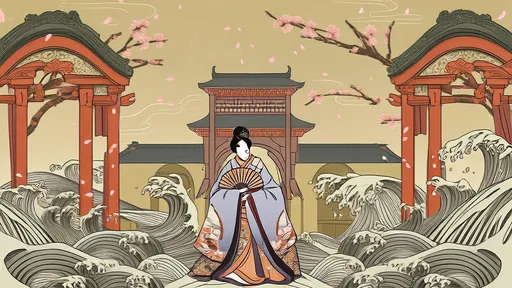
In the grand tapestry of global art history, few movements have woven as intricate and far-reaching a thread as Japanese ukiyo-e. The woodblock prints that emerged during the Edo period did not merely capture the fleeting beauty of the floating world; they embarked on a transcontinental journey that would irrevocably alter the course of Western art. The story of ukiyo-e's world influence is not one of simple appropriation, but a profound dialogue between East and West, a silent revolution sparked by paper and ink.
The initial encounter was not in the hallowed halls of museums, but in the most mundane of packages: shipping crates. In the 1850s and 60s, as Japan cautiously opened its ports to trade after centuries of isolation, these prints were often used as disposable padding for far more valuable cargo like ceramics. To European merchants, they were curious scraps of paper; to the artists who eventually discovered them, they were revelations. Arriving in Paris, the then-capital of the Western art world, these vibrant sheets presented a visual language entirely alien to the European tradition, governed by principles that defied Renaissance conventions.
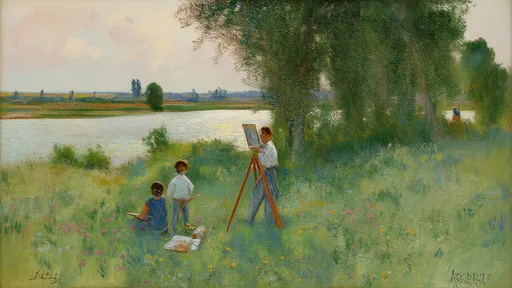
The most immediate and seismic impact was felt by the French Impressionists. For artists like Claude Monet and Edgar Degas, who were already chafing against the rigid academic standards of the Salon, ukiyo-e offered a radical new toolbox. They were captivated by the daring use of flat, unmodulated color, a stark contrast to the painstakingly blended chiaroscuro that defined European painting. The prints demonstrated that depth and atmosphere could be suggested not through gradual shading, but through the strategic placement of forms and the interplay of hues. Furthermore, the audacious and often asymmetrical compositions of masters like Hokusai and Hiroshige were a revelation. Figures were cropped by the edge of the frame, perspectives were dramatically elevated or lowered, and the picture plane was often divided in ways that felt dynamic and modern, not staged and balanced.
This influence permeated the very fabric of Impressionism. Monet’s famed series, such as his Haystacks and Water Lilies, echo the ukiyo-e practice of exploring a single subject through myriad seasonal and atmospheric conditions. His garden in Giverny itself was a living homage to the Japanese landscapes he collected so voraciously. Degas, in turn, adopted the unusual vantage points, capturing ballerinas from behind the scenes or from above, freezing moments of casual movement in a way that felt instantly familiar to a viewer of Utamaro’s courtesans or Sharaku’s kabuki actors. The very goal of the Impressionists—to capture a momentary impression of light and life—was visually validated by these Japanese masters who had been doing precisely that for over a century.
As the art world evolved into Post-Impressionism, the lessons of ukiyo-e were digested and transformed into something even more potent. Vincent van Gogh’s encounter with these prints was nothing short of evangelical. He famously painted meticulous copies of Hiroshige’s prints, not as mere exercises but as attempts to understand their essence. In doing so, he internalized their bold outlines and expressive color, elements that would become fundamental to his own explosive style. The swirling skies of The Starry Night and the thick, dark outlines defining the forms in his later portraits owe a clear debt to the linear strength and emotional force found in ukiyo-e. For van Gogh, they were a testament to the power of art as a direct, emotional language.
Similarly, Henri de Toulouse-Lautrec found in ukiyo-e a spirit that matched the bohemian energy of Montmartre. He adopted the distinctive sinuous line and the focus on the demi-monde—the world of entertainers, performers, and sex workers. His iconic posters for the Moulin Rouge are direct descendants of kabuki advertisements, utilizing flat planes of color, strong graphic patterns, and stylized figures to communicate instantly with a bustling urban audience. He translated the Edo period’s "floating world" into the Parisian nightlife, proving the universal appeal of its themes and aesthetics.
The ripple effects extended beyond painting into the broader sphere of design and aesthetics, culminating in the Japonisme craze. This was more than an artistic trend; it was a cultural fascination that infused furniture, fashion, ceramics, and interior decoration. The clean lines, organic forms, and appreciation for natural materials that characterized the Arts and Crafts movement, led by figures like William Morris, found a kindred spirit in Japanese design principles. The concept of asymmetrical harmony and the appreciation for simplicity and emptiness (ma) began to challenge the cluttered ornamentation of the Victorian era, paving the way for the minimalist ethos of modernism.
Perhaps the most profound and lasting impact of ukiyo-e’s westward journey was its role in deconstructing the Western perspective. For centuries, European art had been bound to a single, fixed-point perspective, creating a window into a simulated world. Ukiyo-e offered a multitude of viewpoints—sometimes within a single image—emphasizing pattern, surface, and the two-dimensionality of the canvas itself. This liberation from strict pictorial depth was a crucial precursor to the abstract movements of the 20th century. Artists like Picasso and Matisse, who collected these prints, learned from them the courage to flatten space, prioritize compositional rhythm over realistic depiction, and see the artwork as an arrangement of forms first and a window to the world second.
In conclusion, the world influence of Japanese ukiyo-e is a testament to art’s power to transcend its origins and become a universal language. It was not a wholesale imitation but a catalytic spark. It provided a generation of Western artists, stifled by tradition, with the permission to see differently: to embrace flatness, celebrate the decorative, capture the transient, and explore the emotional power of line and color. The echoes of Hokusai’s great wave are still felt today, not as a copy, but as a fundamental current in the ongoing stream of global visual culture, a permanent reminder of how beauty discovered in one corner of the world can reshape the vision of all.
By /Aug 28, 2025
By /Aug 28, 2025

By /Aug 28, 2025

By /Aug 28, 2025
By /Aug 28, 2025
By /Aug 28, 2025

By /Aug 28, 2025

By /Aug 28, 2025
By /Aug 28, 2025
By /Aug 28, 2025
By /Aug 28, 2025

By /Aug 28, 2025
By /Aug 28, 2025

By /Aug 28, 2025
By /Aug 28, 2025
By /Aug 28, 2025

By /Aug 28, 2025
By /Aug 28, 2025
By /Aug 28, 2025

By /Aug 28, 2025